The SS4A program provides funding and technical assistance to prevent roadway fatalities and serious injuries and to strengthen communities’ approach to roadway safety for all users.
Grant Recipient Roadmap
Overview
The SS4A Grant Recipient Roadmap includes four main steps and helps grant recipients successfully navigate the program.
The Action Plan section outlines the components of a Comprehensive Safety Action Plan and provides key resources to support SS4A grant recipients throughout the planning process.
The SS4A Technical Assistance Center (TAC) provides resources and training for SS4A grant recipients. The SS4A TAC is part of the broader grant program and provides informational and educational resources for SS4A grant recipients and stakeholders who support SS4A grant recipients.
Community of Practice
An interactive forum for recipients to learn from and share solutions with each other.
Resource Library
One-stop library with relevant resources, trainings, data sources, and noteworthy practices from the U.S. Department of Transportation and other organizations.
Newsletter
SS4A newsletters and blog posts to update recipients on SS4A and SS4A TAC activities.
The Infrastructure Investment and Jobs Act (IIJA) established the Safe Streets and Roads for All (SS4A) grant program with $5 billion in appropriated funds over five years, 2022-2026. The SS4A program funds regional, local, and Tribal initiatives, preventing roadway deaths and serious injuries through the Safe System Approach.
Learn more about the Safe System Approach (SSA)
Grant Types
The program supports the development of a comprehensive safety action plan (Action Plan) that identifies the most significant roadway safety concerns in a community and the implementation of projects and strategies to address roadway safety issues. Action Plans are the foundation of the SS4A grant program. SS4A requires an eligible Action Plan be in place before applying to implement projects and strategies. The SS4A program provides funding for two types of grants:
Planning and Demonstration Grants
Also known as Action Plan Grants in the first grant cycle, Planning and Demonstration Grants provide Federal funds to develop, update, or supplement a comprehensive safety action plan, including through demonstration activities.
Implementation Grants
Implementation Grants provide Federal funds to implement projects and strategies identified in an Action Plan to address a roadway safety problem. Eligible projects and strategies can be infrastructural, behavioral, and/or operational activities.
Want To Learn More?
About SS4A Grants
The SS4A program funds regional, local, and Tribal initiatives through grants to prevent roadway deaths and serious injuries.
How To Apply
The Department of Transportation is currently not accepting applications for the Safe Streets and Roads for All (SS4A) program.
Eligibility and Requirements
The Safe Streets and Roads for All (SS4A) discretionary grant program is focused on improving roadway safety for all users by reducing and eliminating serious injuries and fatal crashes.
Awarded Projects
Check out all Safe Streets and Roads for All (SS4A) grant awards that the U.S. Department of Transportation has announced to date.
SS4A September Community of Practice Meeting: Driving Progress in Rural Communities
Image
The SS4A Technical Assistance Center is excited to invite you to the next session in our “Addressing Roadway Safety” series. The session will focus on success stories, lessons learned, and effective approaches for advancing roadway safety in rural communities. The webinar will highlight strategies for overcoming common challenges, building local support, and achieving meaningful safety outcomes. Guest speakers will share practical strategies and lessons learned from their Action Plan development that you can apply to your project work. As with previous sessions, the discussion will offer actionable insights, whether you’re just starting out or already working on your SS4A project.
May 2026 SS4A Community of Practice Meeting: Identifying High-Injury Networks and High-Risk Networks to Prioritize Roadway Safety Improvements Peer-to-Peer Panel Discussion
Image
The SS4A Technical Assistance Center is excited to invite you to the next session in our “Addressing Roadway Safety” series. The session will focus on how to use data to identify High-Injury Networks (HINs) and High-Risk Networks (HRNs) to help determine priorities for safety improvements.
A HIN is a data-defined set of roadway locations where a disproportionate number of traffic fatalities and serious injuries occur. Relatedly, an HRN builds on crash data by incorporating roadway, traffic, and contextual risk factors to proactively identify locations with an elevated safety risk, including places that may not show a high number of crashes.
A better understanding of HINs and HRNs will help grant recipients strengthen their safety prioritization and ensure that limited funding is spent where it is needed most.
Guest speakers will share practical strategies and lessons learned from their Action Plan development that you can apply to your project work. As with previous sessions, the discussion will offer actionable insights, whether you’re just starting out or already working on your SS4A project.
April 2026 SS4A Community of Practice Meeting: Innovative Technologies and Data-Driven Approaches for Safer Roadways Peer-to-Peer Panel Discussion
Image
April 2026 SS4A Community of Practice Meeting: Innovative Technologies and Data-Driven Approaches for Safer Roadways Peer-to-Peer Panel Discussion
The SS4A Technical Assistance Center is excited to invite you to the next session in our “Addressing Roadway Safety” series. The session will focus on data-driven approaches and innovative technologies that can help improve roadway safety.
By considering different data approaches and examining how emerging technologies can support roadway safety goals, SS4A grant recipients can tailor strategies to their community and identify solutions that may not be evident through more traditional approaches to safety planning.
Guest speakers will share practical strategies and lessons learned from their Action Plan development that you can apply to your project work. As with previous sessions, the discussion will offer actionable insights, whether you’re just starting out or already working on your SS4A project.
March 2026 CoP Peer Exchange: Data Analysis and Risk-Based Safety Planning for Tribal Grant Recipients
Image
During the March peer exchange SS4A Tribal grant recipients heard from the SS4A TAC about noteworthy practices and lessons learned on how to conduct data analysis and risk-based safety planning. Participants gained practical solutions and insights that can be used to strengthen stakeholder engagement in their own communities.
The FHWA Safe Streets and Roads for All (SS4A) team is hosting the SS4A FY25 Grant Agreement Template Webinar. The webinar will provide SS4A FY25 grant recipients with background on the grant agreement process as well as an overview of how to complete the Grant Agreement template with instructions and best practices.
January 2026 SS4A Community of Practice Meeting: Addressing Accessibility Strategies for Safer Roadways Peer-to-Peer Panel Discussion
Image
As a follow-up to the previous Safe Streets and Roads for All (SS4A) panel discussion on vulnerable road users, the SS4A Technical Assistance Center is excited to invite you to the third session in our "Addressing Roadway Safety" series focused on accessibility strategies to improve roadway safety.
Planning, designing, and implementing accessible infrastructure, ensuring adequate crossing times, and providing well-designed pathways can lower safety risks on our Nation's roadways. Effective, accessible design and planning ensure that the needs of all roadway users are met.
Guest speakers for this event will discuss practical strategies and lessons learned that you can use to incorporate accessibility strategies into your project work. Similar to previous sessions, the discussion will provide actionable tips, whether you're just starting out or already working on your SS4A project.
The webinar will include an overview of the SS4A grant program and resources available on the SS4A Clearinghouse website. In addition, the webinar will include a Q&A session to address questions you may have about SS4A TAC offerings.
December 2025 SS4A Community of Practice (CoP) Peer Exchange on Engagement Strategies with Transitory Populations
Image
During the session, SS4A grant recipients will hear from the City of Corvallis (Oregon) about noteworthy practices and lessons learned engaging with transitory populations (e.g., college or university students) on roadway safety efforts. Attendees will join small breakout rooms with the SS4A TAC team and discuss possible strategies with one another. Participants will gain practical solutions and insights that can be used to strengthen stakeholder engagement for nontraditional stakeholders in their communities.
Date & Time
December 2025 SS4A Community of Practice Meeting: Improving Safety for Vulnerable Road Users Peer-to-Peer Panel Discussion
Image
As a follow-up to the previous Safe Streets and Roads for All (SS4A) panel discussion on rural roadway departures, the SS4A Technical Assistance Center team is excited to invite you to the next session in our “Addressing Roadway Safety” series focused on safety for vulnerable road users (VRUs).
Data shows that fatalities among vulnerable road users have increased steadily in recent years, even as overall traffic deaths have begun to decline. This trend underscores the disproportionate risk these road users face in roadway crashes. The panel will discuss practical strategies and lessons learned that you can use to improve roadway safety for vulnerable road users in your community. As with previous sessions, the discussion will provide actionable tips whether you’re just starting or already working on your SS4A project.
This webinar reviews the quarterly reporting requirements for SS4A grant recipients, including the two quarterly reporting forms: Performance Progress Report and Federal Financial Report. The webinar provides an overview of the key parts, fields, and data required in each form.
September 2025 SS4A CoP Peer Exchange: Stakeholder Engagement Strategies
Image
The September peer exchange will give SS4A grant recipients the chance to join small breakout rooms of their choice and hear directly from peers about how they're engaging with key stakeholders on their roadway safety efforts. Participants will gain practical solutions and insights that can be used to strengthen stakeholder engagement in their own communities.
Planned breakout topics will include engagement strategies with:
State Departments of Transportation
General Public
Community-based Organizations
July 2025 SS4A Community of Practice Meeting: Addressing Rural Roadway Departures Peer-to-Peer Panel Discussion
Image
Did you know that roadway departure crashes – when a vehicle crosses an edge line, center line or otherwise leaves the traveled way – are one of the leading causes of serious injuries and fatalities on our Nation’s roadways? Thankfully, there are many resources available to help address the cause of these crashes and their severity when they do happen.
The Safe Streets and Roads for All (SS4A) Technical Assistance Center is excited to invite you to an upcoming SS4A Community of Practice webinar with guest speakers who will share how roadway departures have affected their rural communities and what they’re doing to prevent them. Whether you’re just getting started or already working on an SS4A project, this discussion will offer practical tips and real-world strategies that you can use to help make your community’s roadways safer.
June 2025 SS4A CoP Information Sharing Peer Exchange
Image
Are you interested in discussing noteworthy practices, challenges, and lessons learned with other SS4A grant recipients? Would you like to identify potential areas of collaboration with your peers? Join the SS4A Technical Assistance Center (TAC) team for our next peer exchange, where you will have a chance to meet and share information with your peers in small breakout rooms.
Date & Time
April 2025 SS4A CoP Peer Exchange: Your Comprehensive Safety Action Plan and Leadership Commitment
Image
The April peer exchange will focus on the Leadership Commitment component of your comprehensive safety action plans (Action Plan). This exchange is open to SS4A Action Plan grant recipients that already have an executed grant agreement. Please complete the sign-up form linked above if you are interested in participating.
December 2024 SS4A CoP Peer Exchange: Safety Social
Image
Are you interested in discussing roadway safety insights and lessons learned with like-minded SS4A grant recipients? Would you like to identify potential areas of collaboration with your peers? Join the SS4A team for an hour of networking with your peers to learn about their Action Plans and development process.
Date & Time
Introductory Webinar for FY24 SS4A Grant Recipients
Image
This webinar will provide SS4A FY24 grant recipients with an introduction to the SS4A program and describe next steps in developing and executing grant agreements. In the webinar recording, program overview runs from 00:00-20:04, and grant agreement familiarization runs from 20:05-end.
September 2024 Community of Practice Meeting: The Safe System Approach Peer-to-Peer Panel Discussion
Image
The Safe System Approach (SSA) continues to be embraced by the transportation community as an effective way to address and mitigate the risks inherent in our complex transportation system. This approach focuses on both human mistakes AND human vulnerability and designs a system with many redundancies in place to protect everyone. In this webinar, fellow SS4A grant recipients will share their experiences incorporating this approach into their comprehensive safety action plans and projects. Participants will hear first-hand from their peers about how they made the SSA a key part of their efforts, the thought processes involved, and the factors that influenced and shaped their final products.
August 2024 SS4A CoP Peer Exchange: Comprehensive Safety Action Plans and Your Safety Story
Image
The SS4A Community of Practice's third peer exchange will be on Wednesday, August 28, 2024 and will focus on Comprehensive Safety Action Plans (Action Plans) and your safety story. The August Peer Exchange is open to Planning and Demonstration grant recipients working on their Action Plans. The August meeting will be limited to 50 participants.
July 2024 Community of Practice Meeting: Safe System Approach
Image
During the July Community of Practice meeting, FHWA will provide an in-depth review of the Safe System Approach and discuss how SS4A grant recipients can use the Safe System Approach to maximize the benefits of their projects.
Introductory Webinar for FY24 SS4A Grant Recipients
Image
This webinar will provide SS4A FY24 grant recipients with an introduction to the SS4A program and describe next steps in developing and executing grant agreements. In the webinar recording, program overview runs from 00:00-21:44, and grant agreement familiarization runs from 21:45-end.
April 2024 Community of Practice Meeting: Procurement
Image
The April Community of Practice meeting provides SS4A grant recipients with information related to procurement standards documented within 2 CFR 200. The webinar discusses the 2 CFR 200 requirements that dictate how grant recipients acquire goods and services and answers questions about the procurement process.
The SS4A Community of Practice's inaugural peer exchange focuses on data collection. The March exchange is open to rural Planning and Demonstration grant recipients who are not using consultants or contractors for their data analysis. The March meeting is limited to 40 participants.
The SS4A Initial Webinar for Grant Recipients describes next steps for grant recipients and Division Office staff. Topics include program overview, roles and responsibilities, key program requirements, and preparing for the project kick-off meeting. In the webinar recording, program overview runs from 00:00-22:02, and grant agreement familiarization runs from 22:03-end.
The Community of Practice Kickoff Meeting describes the benefits of SS4A grant recipient participation in the CoP and opportunities for grant recipients to get involved. The meeting also includes a presentation from the Vision Zero Network about building strong stakeholder coalitions.
The SS4A Community of Practice (CoP) serves as an opportunity for grant recipients to share noteworthy practices, resources, and solutions to advance roadway safety at the regional, local, and Tribal levels.
Opportunities to Get Involved
CoP Meetings
Who: Grant recipients
What: Webinars with guest speakers and subject matter experts on relevant grants management and roadway safety topics
When: Quarterly
Peer Exchange Meetings
Who: Select grant recipients, based on topic and meeting audience
What: Facilitated discussions for small groups on specific roadway safety or Action Plan development topics
When: Quarterly
Success Stories
Who: Anyone
What: Sharing a project story, case study, or win that others can learn from
When: Ongoing
Submit Your Success Story
Image Credit: AdobeStock_300144034
Please contact the SS4A team to share your success story that could be featured on the CoP webpage as a case study or notable practice and shared with other grant recipients.
Quarterly Newsletters and Blog Posts
SS4A Spring 2026 Newsletter
In this edition of the SS4A Quarterly Newsletter, you’ll find new Action Plan resources, tools, real-world examples, and noteworthy practices available on the SS4A Clearinghouse website to support grant recipients. We also highlight the FY25 grant recipients announced in late 2025 and the latest traffic safety data from NHTSA.
In this edition of the SS4A Quarterly Newsletter, we highlight new updates to the SS4A Clearinghouse website, including the Action Plan Hub and SS4A TAC Talks. You'll also find resources to support stakeholder engagement and quarterly reporting, as well as safety success stories from SS4A grant recipients across the country.
In this edition of the SS4A Quarterly Newsletter, we spotlight the growing impact of SS4A funding, with over 1,800 grants awarded to help communities advance roadway safety. You'll find inspiring stories of local success along with practical resources to support your progress, including tools for navigating reimbursements and preparing for future funding opportunities.
We’re thrilled to share with you the third edition of the Safe Streets and Roads for All (SS4A) newsletter! In this edition, you will find program updates, our first grant recipient story highlight, new resources and trainings, and a spotlight on The National Center for Rural Road Safety. This edition also explores how equity can be incorporated into roadway safety strategies and offers advice on how to address upstream factors to create a more equitable Safe System Approach.
We’re celebrating an exciting and productive past few months, where USDOT has achieved significant milestones, including publishing the FY24 NOFO and the launch of the SS4A Clearinghouse website, a one-stop shop for technical assistance and resources.
As the SS4A team reflects on the past year, we are excited to share our progress in the first edition of our quarterly newsletter. This publication will share program updates, highlight key developments, and provide a sneak peek into upcoming activities.
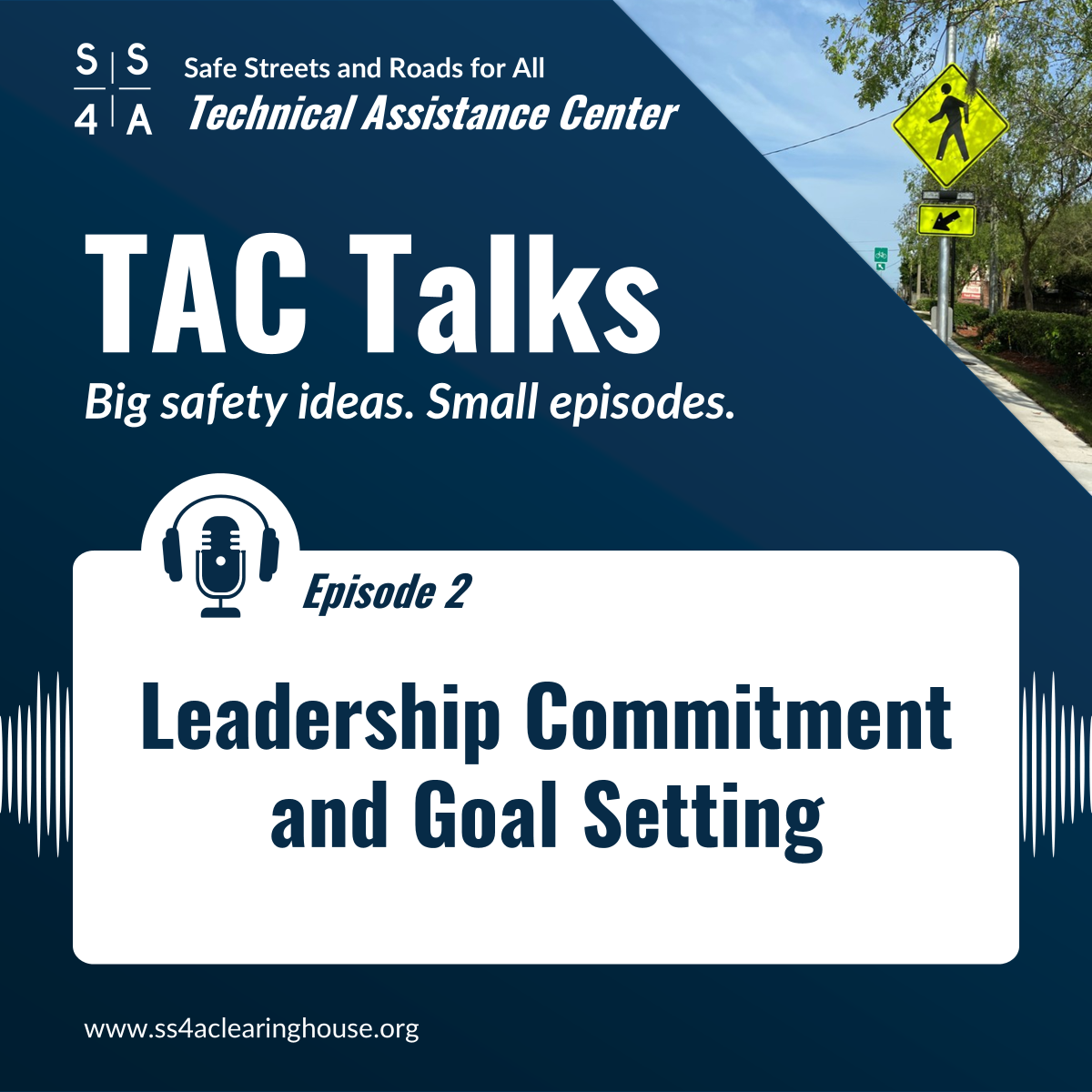
TAC Talks are a podcast-style series that equips SS4A communities with practical insights to strengthen their transportation safety strategies. In each episode, you’ll hear from safety experts on a range of safety topics, challenges, and proven strategies to address them.
Whether you're just getting started or working through the details, the TAC Talks series will support your efforts to plan, implement, and sustain safety improvements.
Listen now and start building safer streets one episode at a time!
Episodes
Episode 10: Leadership Change and Policy Connections
Image
Guest expert Catherine Saine explores how communities can sustain momentum through leadership transitions and use policy to create lasting roadway safety improvements. From building a network of safety champions to leveraging data, stakeholder engagement, and non-infrastructure solutions, this conversation highlights practical strategies for embedding safety into community decision-making and advancing Action Plans beyond any single leader.
To access the video, use the recording passcode: D%aFp8tE
Episode 9: The Three Approaches to Safety Analysis
Image
Guest expert Dr. Shakir Mahmud breaks down site-specific, systematic, and systemic approaches to safety analysis and how communities can use them together to reduce severe crashes. From identifying high-risk locations to proactively addressing underlying risk, this conversation highlights practical strategies to target investments and prevent future crashes.
To access the video, use the recording passcode: 3^By2j7X
Guest expert Kara Peach breaks down how Progress and Transparency transform an SS4A Action Plan from a static document into a living, accountable strategy for safer streets. From developing SMART performance measures that track meaningful outcomes, to creating accessible public reporting tools like dashboards and annual updates, this conversation highlights practical approaches for measuring success, building trust, and using data and feedback to continuously improve roadway safety over time.
To access the video, use the recording passcode: 2xv#K?1G
Guest expert Eric Tang walks through how communities can take a structured approach for Strategy and Project Selections in an SS4A Action Plan. From synthesizing crash trends and community feedback, to building comprehensive lists of potential solutions, to prioritizing projects using transparent criteria, this conversation highlights how to connect analysis with action.
To access the video, use the recording passcode: jHE&0JL+
Guest expert Eric Tang unpacks how policy and process changes strengthen SS4A Action Plans by embedding safety into everyday decision-making. This discussion highlights practical ways to align existing policies and plans with safety goals, navigate adoption processes, and ensure new policies become lasting components of a community's safety strategy.
To access the video, use the recording passcode: *0rLd&2?
Guest expert Eric Tang breaks down how meaningful engagement and collaboration transform an Action Plan from a technical document into a community-driven roadmap for safer streets. From identifying who to engage, to removing participation barriers, to aligning community input with data and project priorities, this conversation highlights practical, creative approaches for building trust, fostering shared ownership, and keeping partnerships strong throughout the life of an Action Plan.
To access the video, use the recording passcode: Ta4*Ep.2
Guest expert Jeff Gooch unpacks how Safety Analysis transforms data into action, helping communities pinpoint risks and prioritize projects that save lives. From blending crash data with community insights to communicating findings in clear, visual ways, this conversation offers practical steps for turning information into impact.
To access the video, use the recording passcode: 7tUf&zMi
Guest expert Eric Tang breaks down how a strong Planning Structure serves as the backbone of every successful Action Plan. From bringing the right voices to the table to sustaining collaboration and accountability through implementation, this conversation offers practical guidance for building a team that drives lasting safety outcomes.
To access the video, use the recording passcode: W+3w2Q6a
Guest expert Catherine Saine explores how Leadership Commitment fuels lasting change in roadway safety. From identifying stakeholders to formalizing commitments and sustaining momentum through leadership transitions, this conversation offers practical strategies for securing strong, visible support for Action Plans.
To access the video, use the recording passcode: 49?nlwCg
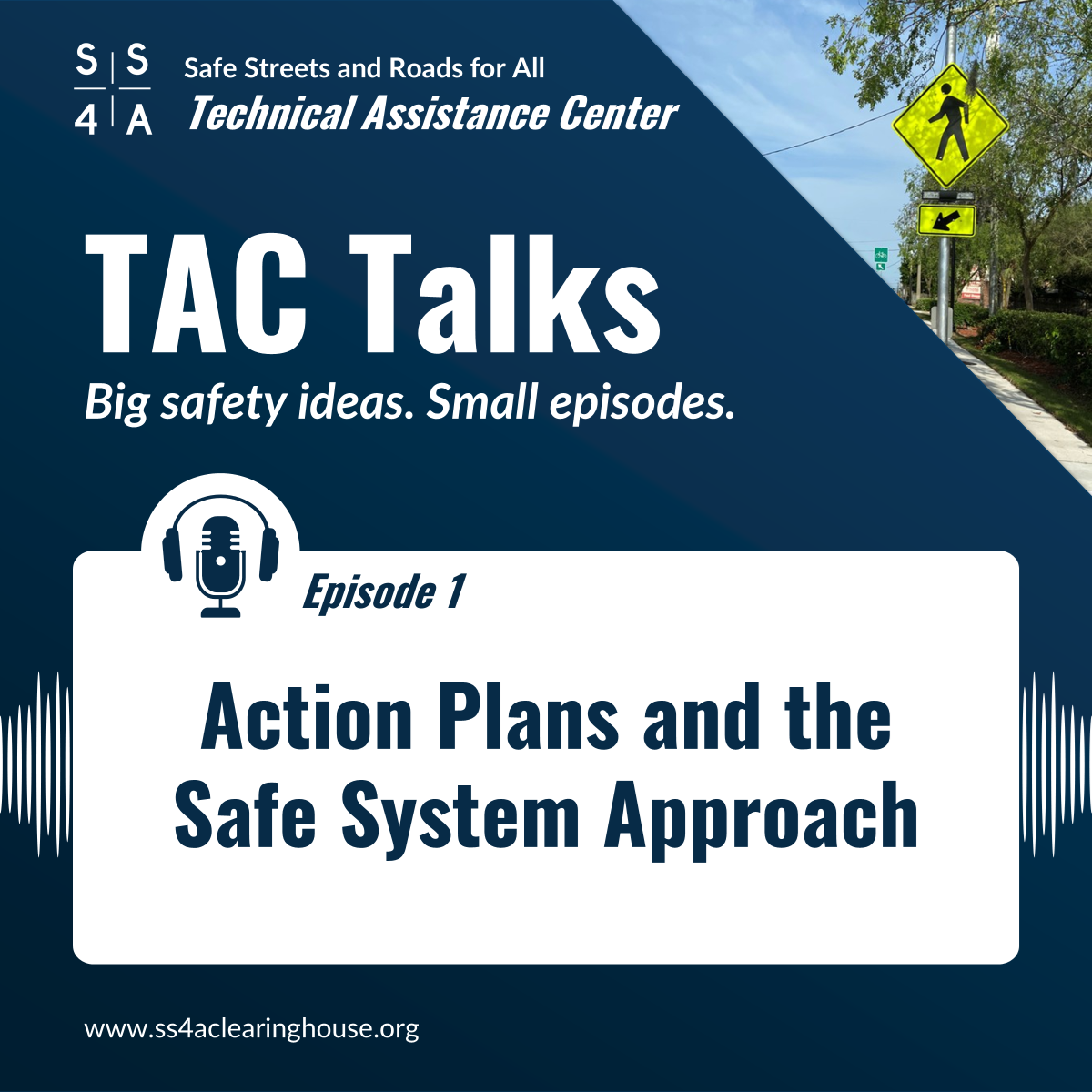
Episode 1: Action Plans and the Safe System Approach
Image
Guest expert Michael Dunn breaks down the fundamentals of the Safe System Approach and Action Plans, showing how communities can use these two tools to create a safer, more resilient transportation system.
To access the video, use the recording passcode: ^Y9S4e*U
SS4A grant recipients should reach out to their designated SS4A POC and let them know of any changes. If you don’t know who your POC is, please send an email with your award year, recipient entity name and/or grant title to the SS4A team at SS4A.FHWA@dot.gov.
SS4A grant recipients are assigned a primary SS4A point of contact (POC) throughout the SS4A grant program and can reach out to them at any time. If a recipient doesn't know who their POC is, please send an email with recipient entity name and/or grant title to the SS4A team at SS4A.FHWA@dot.gov. If an SS4A grant recipient is interested in being added to the Community of Practice (CoP) mailing list, please contact SS4A.FHWA@dot.gov. Finally, if an SS4A grant recipient doesn't know where to start, please reach out to SS4A.FHWA@dot.gov for help.
Welcome! Use the Grant Recipient Roadmap to find key information and resources for each grant step. This Roadmap provides a high-level overview of the four SS4A program steps: Onboarding, grant agreement execution, grant administration and reporting, and project closeout. Specifically, the overview includes the timing, activities, requirements, and outcomes of each step.
Infrastructure projects and demonstration activities are subject to the Build America, Buy America Act (Pub. L. No 117–58, div. G §§ 70901–70927) as clarified in OMB Memorandum M-22-11.31. Additional information on construction materials requirements can be found at the FHWA Construction Program Guide webpage. The Department does not expect to provide waivers related to domestic preference requirements for demonstration activities focused on piloting technologies.
SS4A grant recipients are subject to the National Environmental Policy Act (NEPA) and other environmental laws. Project sponsors must conduct the applicable environmental studies to identify the project impacts along with any required mitigation. NEPA and environmental resource subject-matter experts should develop materials that identify and evaluate impacts to human and natural resources including the following: Low income/minority communities, Historic properties, Park and recreation lands, Wildlife and waterfowl refuges, Wetlands, and Threatened and endangered species and their habitats. Project sponsors should also assess the need to obtain new rights-of-way and evaluate those impacts. If the project sponsor lacks staff with the specific skills, knowledge, and experience to conduct environmental studies, they are obliged to engage staff expertise at their State Departments of Transportation or fund consultants/contractors. Hiring consultants/contractors to directly support the execution of the grant award and its activities is considered an eligible cost under the grant. For demonstration activities that involve feasibility studies using quick-build strategies, the Department expects most quick-build activities to receive a Categorical Exclusion designation. FHWA’s Overview of NEPA as Applied to Transportation Projects - Environment - Federal-aid Essentials for Local Public Agencies provides training materials and resources that will help applicants better understand the requirements of NEPA and other federal laws and requirements for projects administered by FHWA.
The U.S. Department of Transportation’s Federal Highway Administration (FHWA), National Highway Traffic Safety Administration (NHTSA), and Federal Transit Administration (FTA) have responsibility for administering all SS4A grants. Grant recipients whose award is administered by NHTSA and FTA can still contact the SS4A inbox with questions.
Combining the FY22, FY23, FY24 and FY25 awards, SS4A has provided $3.9 billion in Federal funding to improve safety in over 2,000 communities in all 50 States and Puerto Rico. Through this important funding source, USDOT is empowering Tribal, local, and regional efforts to save lives and reduce serious injuries on our roadways.
The Infrastructure Investment and Jobs Act (IIJA) established the Safe Streets and Roads for All (SS4A) discretionary grant program with $5 billion in appropriated funds over five years. The SS4A program funds regional, local, and Tribal initiatives through grants to prevent roadway deaths and serious injuries. The SS4A program supports the U.S. Department of Transportation's National Roadway Safety Strategy and FHWA's goal of zero roadway deaths using a Safe System Approach. For more information about SS4A, visit the U.S. Department of Transportation website.
Yes. An SS4A grant recipient may establish an arrangement with a State DOT or another State or local governmental entity to administer an SS4A grant so long as that arrangement complies with State and local law. Under 2 CFR § 200.331, the recipient must determine whether such arrangement is contractual, such as an interagency agreement, or a subgrant. As provided at 2 CFR § 200.300(b), the recipient is responsible for compliance with all Federal requirements applicable to the award. States will not have direct funding relationships with USDOT.
No. Implementation Grant applications can include a funding request to complete necessary analyses for NEPA and other environmental laws, including the National Historic Preservation Act, NHPA, as part of an Implementation Grant under eligible activity (B) project and strategy-specific planning, design, and development activities. The NEPA and NHPA processes must be complete prior to funds being released for construction.
Being “in progress” means that an SS4A grant recipient's jurisdiction has already started the process of completing the various Action Plan components found in Table 1 of the FY25 Notice of Funding Opportunity (NOFO) linked below (e.g., gathering and analyzing safety data, performing public outreach, etc.). Action Plan Grant award recipients who intend to establish grant agreements would have plans that qualify as “being in progress,” as well as communities that are developing Action Plans that meet the SS4A components but are being created without SS4A funding. Given that eligible demonstration activities and supplemental planning efforts must ultimately inform an Action Plan, FHWA will consider funding requests for demonstration or supplemental planning activities only from applicants who already have an existing plan or are working to develop a safety Action Plan.
A local match of no less than 20 percent of the total project cost is required for all SS4A grant funds. Local match may include both cash as well as in-kind contributions. Details on cost-sharing and match can be found in 2 CFR § 200.306. Further guidance, illustrative examples, and guidance about how to calculate match can be found in the SS4A Match and Cost Share Examples Fact Sheet.
Potential applicants can visit the U.S. Department of Transportation website for additional information related to pre-award activities, including information about eligibility.
Potential applicants can visit the U.S. Department of Transportation website for additional information related to pre-award activities, including information about applying for a grant.
The primary SS4A point of contact (POC) assigned to each grant will contact the identified SS4A grant recipient POC to schedule a kickoff meeting. In the meantime, SS4A grant recipients can review the SS4A Introductory Webinar, on Step 1 of the Grant Recipient Roadmap, to learn more about how to start their SS4A journey.
SS4A grant recipients can send an email with their recipient entity name and/or grant title to the SS4A team at SS4A.FHWA@dot.gov, and the SS4A TAC team will connect them with the appropriate primary SS4A point of contact (POC). In the meantime, SS4A grant recipients can review the SS4A Introductory Webinar, on Step 1 of the Grant Recipient Roadmap, to learn more about how to start their SS4A journey.
U.S. Department of Transportation expects to obligate SS4A funding via a signed grant agreement between the Department and the SS4A grant recipient within 12 months after awards have been announced. Individual grant recipient timelines may vary depending on the complexity of project, status of project readiness, and other factors. Funding is expected to be provided on a reimbursement basis once a grant agreement is established, with corresponding invoices. In the meantime, SS4A grant recipients can review the SS4A Introductory Webinar, on Step 1 of the Grant Recipient Roadmap, to learn more about how to start their SS4A journey.
The five-year clock starts on the date the grant agreement is fully executed, which means it has been signed by both the SS4A grant recipient and the FHWA Agreement Officer.
SS4A grant agreements are directly between the applicant and USDOT. SS4A grant agreements are not with State DOTs, and eligible applicants cannot serve as a pass through for a State DOT to take full responsibility over the grant agreement. However, an applicant may choose to work with a State DOT and provide SS4A grant funding to State DOTs to assist in the execution of the grant activities separately from the grant agreement. But the SS4A grant recipient retains responsibility for ensuring completion of the grant activities and for compliance with the terms of the grant award and Federal requirements.
SS4A grant recipients will work with their assigned primary SS4A point of contact (POC) to execute their grant agreement. The POC will provide initial guidance during a kickoff meeting, share the grant agreement template, and answer any questions. SS4A grant recipients should also review the grant agreement general terms and conditions posted on the U.S. Department of Transportation website. Additionally, FHWA hosts an introductory grant agreement webinar after new recipients are announced. During this webinar, FHWA will talk about the grant agreement template as well as resources to help complete the template (e.g., SS4A grant application, award email from the Office of the Secretary of Transportation, and sam.gov account).
The timeline depends on the specific circumstances of each grant. Individual timelines may vary but SS4A grant recipients should target to execute their grant agreements within the first 12 months of award notification. Typically, Planning grant agreements will take less time than Demonstration project or Implementation grant agreements. In the meantime, SS4A grant recipients can review the SS4A Introductory Webinar, on Step 1 of the Grant Recipient Roadmap, to learn more about how to start their SS4A journey.
Yes, each grant recipient will develop the grant agreement using the approved grant agreement template, which may be obtained from the primary SS4A point of contact (POC) assigned to the grant. The POC can help answer any questions. Additionally, FHWA hosts an introductory grant agreement webinar after new recipients are announced. During this webinar, FHWA will talk about the grant agreement template as well as resources to help complete the template (e.g., SS4A grant application, award email from the Office of the Secretary of Transportation, and sam.gov account).
SS4A grant recipients should contact their primary SS4A point of contact (POC) assigned to their grant to obtain a copy of the grant agreement template. They can also visit the U.S. Department of Transportation website for the grant agreement terms and conditions.
SS4A grant recipients will receive more information about this from their primary SS4A point of contact (POC) during a grant recipient kickoff meeting. Additionally, FHWA hosts an introductory grant agreement webinar after new grant recipients are announced. During this webinar, FHWA will talk about the grant agreement template as well as resources to help complete the template (e.g., SS4A grant application, award email from the Office of the Secretary of Transportation, and sam.gov account). SS4A grant recipients can find the recordings of past webinars on the SS4A Clearinghouse website.
SS4A grant recipients must follow their organization's written procurement guidelines and comply with all applicable Federal requirements, including but not limited to 2 CFR 200.317 thru 200.327, 2 CFR 200.400 thru 200.401, 2 CFR 200.403 through 200.405, and 2 CFR 200.430. For more information on contracting and subawards, grant recipients can refer to Article 18 within the General Terms and Conditions in their respective executed grant agreement as well as the SS4A April 2024 Community of Practice webinar on procurement.
Depending on the timing of the executed grant agreement, an amendment may not be required. SS4A grant recipients should contact their primary SS4A point of contact (POC) to determine if an amendment is required. It is important to keep in mind that consultants are not official representatives of an SS4A grant recipient for administrative requirements and matters like certifications that may be required and invoice submittals.
Infrastructure safety projects that receive Federal funds must abide by any applicable Federal design standard requirements, including but not limited to the Manual on Uniform Traffic Control Devices, as well as any applicable guidance. Grant recipients may also be required to follow any applicable State design standards, which will depend on whether the activities are occurring on a State-owned road and the extent to which State design standards apply to roadways owned by non-State entities such as in the instance of county-owned roads or local roads maintained and owned by a city. Applicants should indicate in their application if they will be seeking permission to use roadway design standards that are different from those generally applied by the State in which the project is located.
The goal of an Action Plan is to develop a holistic, well-defined strategy to prevent roadway fatalities and serious injuries in a locality, Tribal area, or region. A successful Action Plan includes the following seven key components, which are described in more detail in the Action Plan Components PDF. Aside from the key components, impactful Action Plans are developed in coordination with broad coalitions – such as political leaders, State Department of Transportation officials, law enforcement, and the public – to facilitate early buy-in and Action Plan sustainability. SS4A grant recipients can also review the "Comprehensive Safety Action Plans" section of the SS4A Clearinghouse to learn more.
Yes. Under 2 CFR § 200, Subpart E, these costs may be reimbursed either as indirect costs if such costs are included in the grant recipient’s approved indirect cost rate, or as a direct cost if the cost is incurred specifically for the award and not otherwise accounted for the approved indirect cost rate. If a grant recipient intends to enter into such an arrangement and seek reimbursement of direct costs through the grant, those estimated costs should be included in the grant application. During administration, the grant recipient is responsible for ensuring direct costs incurred are eligible and allocable to the grant administration. States will not have direct funding relationships with USDOT. Additional information on reimbursement can be found in the SS4A Payment Request Quick Guide.
The expected period of performance for Planning and Demonstration Grant agreements is between 12 months and five years, depending on the scope and extent of grant activities. The period of performance for Implementation Grant agreements may not exceed five years.
To close out their grant, grant recipients must complete their required reports, submit their final request for reimbursement, and work with FHWA to initiate a closeout grant agreement amendment. Grant recipients will need to work with FHWA to make sure that all requirements are satisfied in a timely manner and that their grant is successfully closed out.
Action Plans can contain a variety of strategies to help with this. A good start is for SS4A grant recipients to look at their data as it relates to distracted driving-related crashes. Review community crash data to see when, where, and how these crashes are happening. SS4A grant recipients can also review the "Comprehensive Safety Action Plans" section of the SS4A Clearinghouse to learn more.
There’s a resource on roundabouts and emergency services available on the U.S. Department of Transportation website. The SS4A Technical Assistance Center's general advice to agencies pursuing their first roundabout is to go above and beyond the norm for coordinating with Fire and Emergency Medical Services, including them in the preliminary planning and design, all the way through construction and opening. It sometimes helps to hold a “test drive” where the basic geometry is laid out using cones and sandbags in a parking lot or field, having the Department drive through and observe the results, and then use that information to tweak the design. There are also design details that can make a huge difference, such as truck aprons and sloped curbing.
The SS4A Technical Assistance Center offers resources and support for SS4A grant recipients. Please contact SS4A.FHWA@dot.gov and a member of the SS4A TAC team will respond.
As the SS4A TAC continues to build and create new resources, it will rely on SS4A grant recipient input and recommendations. Please contact SS4A.FHWA@dot.gov with any topics of interest or to provide feedback.
The SS4A TAC team will continue to provide CoP updates on the SS4A Clearinghouse. The SS4A TAC team also emails CoP event information to all SS4A grant recipients and interested stakeholders. Please contact SS4A.FHWA@dot.gov to be added to the CoP mailing list.
To the extent possible, the SS4A Technical Assistance Center (TAC) encourages CoP members to collaborate with one another. In the coming months, the SS4A TAC will ask CoP participants about their preferences on sharing contact information. Please stay tuned for more information.
SS4A grant recipients are encouraged to join the SS4A CoP if they are interested in contributing to a goal of reducing roadway fatalities and serious injuries. Let’s all work together to share roadway safety challenges and solutions.
SS4A grant recipients can get involved by joining quarterly CoP and peer exchange meetings, and access multiple resources available on the SS4A Clearinghouse. Please email us at SS4A.FHWA@dot.gov and share any topics of interest for a future meeting or a success story or best practice.





 Visit All FAQs